Mountain bongo sighting suggests species is re-emerging.
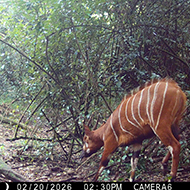
New trail camera photographs have unexpectedly shown the wild mountain bongo in a Kenyan forest.
The antelope, which had previously been detected in four isolated areas, was believed to have shrunk to just a tiny range in the Aberdare mountains in Kenya.
However, new footage now places antelopes at a forest fragment near Massai Mau, roughly 200km from the Aberdares population.
This latest discovery follows a hi-tech survey of the animal, which was carried out in 2025 by Chester Zoo. The zoo took guidance from the Mountain Bongo Project (MBP) and had support from the Mountain Kenya Wildlife Conservancy (MKWC) and Kenya Wildlife Service.
The survey, performed using artificial intelligence, found just 28 individual mountain bongos in the Aberdares stronghold. Rangers from MBP have similarly confirmed there to be less than 40 bongos in Aberdares.
A mature male captured in a photograph is believed to be one identified by Tommaso Sandri, of Chester Zoo, in 2018. Dr Sandri theorised that, since this bongo had been hidden for years, other bongos may also be in the area.
Further pictures proved this theory, with markings analysis confirming these to show an additional young male and young female.
Dr Sandri said: “This is huge news. Unlike Aberdares, Maasai Mau is not a national park, and the reappearance of bongo may focus organisations on increasing broader protections.
“It’s a testament to the persistence of the MBP rangers who work in incredibly difficult and isolated conditions to monitor and protect this antelope.”
Bongo conservationists, led by experts from Chester Zoo, are developing a new action plan to coordinate bongo safeguarding work. The plan will be published soon.
There are currently 900 bongos in zoos and sanctuaries. Some conservation plans anticipate reintroducing mountain bongos into the wild to preserve genetic diversity.
A recent translocation of four European-born male mountain bongos, co-ordinated by Chester Zoo, has reinforced the sanctuary population in Kenya.
Dr Sandri added: “I believe the world would be poorer for their loss. Their presence makes the forest more magical. This is a problem caused by people, and we need people to fix it.
“Without everyone sharing their expertise and resources, the bongo could be lost.”
Image © Chester Zoo






 Defra has published guidance for the vet sector ahead of a proposed UK-EU Sanitary and Phytosanitary agreement.