The study documented friendly interactions between non-human primates and other species.
The study is the first to map the surprising relationships.
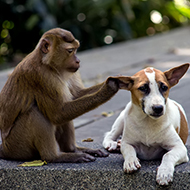
Macaques grooming domestic dogs in Thailand and snub-nosed monkeys playing with domestic pigs in China are some of the unlikely friendships revealed in a new study exploring the behavioural foundations of human-animal companionship.
The international study led by the University of Oxford also documents an extraordinary case of wild capuchin monkeys adopting an infant marmoset, and caring for it over many months. The findings are published in the journal Primates.
Lead author Associate Professor Cyril C. Grueter, from the School of Anthropology and Museum Ethnography at the University of Oxford, said: “Humans have long been considered unique in forming close social relationships with other species.
“Our study shows that many primates also display remarkable curiosity, tolerance and even caregiving towards animals that are not their own species. These behaviours don't amount to pet-keeping as we know it, but they may represent some of the evolutionary building blocks from which human-animal companionship eventually emerged.”
In this first-of-its-kind study, researchers conducted a comprehensive review of friendly interactions between non-human primates and other species. They documented 427 cases involving 88 primate species and 127 partner species, 55 of them non-primates.
Combining evidence from scientific literature, media reports and a survey of primatologists, the study reveals that monkeys and apes frequently play, groom, hold, carry and even adopt animals from other species. Juveniles were much more likely to play with members of other species, while adult females were more likely to groom them.
The study also found that primates most often formed relationships with closely related species, although many interactions involved distant relatives such as birds, dogs and squirrels. Primates generally initiated these friendships themselves.
Not all of these relationships were positive, however. The team recoded 13 cases in which a partner animal died, including a baboon in Saudi Arabia who appeared to kidnap a domestic puppy.
Dr Grueter believes that understanding why some species form positive relationships with others could help zoos and sanctuaries improve the management of mixed-species groups.
“More broadly, these findings provide new insights into the evolution of empathy, social flexibility and the remarkable capacity of primates to engage with animals beyond their own species,” he said.
Image (C) Anatolii Kostyk/Shutterstock.com





 Vets wishing to access TB Advice services can now use a digital contact form, following updates announced by the APHA.