Welcome to vnonline.co.uk

vnonline.co.uk provides the veterinary nursing profession with the latest news and industry developments, as well as events, resources, learning materials and careers.

Our website is dedicated to veterinary nurses and we strive to provide a platform where you can voice and explore your interests.

Not a member yet? Sign up for free!

Register for free with vnonline.co.uk to gain unlimited access to news, resources, jobs and much more!




Click here to become a member


Log in to vnonline

Forgot your password?

Posted: 16th March 2026

‘Propeller theory’ may explain wing and fin evolution
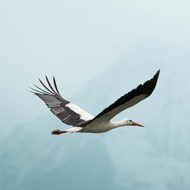
Storks' feathers may be acting as high-performance fans.
The study explores how different shapes impact flight and swimming.

Researchers from the Royal Veterinary College (RVC) have linked a mechanical principle with the evolution of wings and fins.

The new study suggests that the same equations used to design propellers could be applied to theories of swimming and flapping flight. This could explain why pike, tuna, vulture and swifts travel so differently.

A pike, for example, has a broad tail which it uses for quick acceleration, whereas the tuna cruises at high speed with its narrow, crescent shaped tail. Scientists had considered the pike’s broad tail as a trade-off, prioritising raw power over efficiency.

Applying propeller theory, however, could challenge beliefs that some animals sacrifice efficiency for raw power.

The study has been led by Professor Jim Usherwood, a professor in locomotor biomechanics at the RVC. He suggests that the breadth of wings and fins is optimised for each species for maximum efficiency at their respective speeds.

This theory also offered a new explanation for the fingered wingtips of soaring birds like vultures and storks.

The separated feathers, known as emarginate primaries, may be acting like high-performance fans. This allows large birds to be efficient in low flight speeds, as well as generating massive thrust for loaded or rapid take-off.

This would explain why the feature is not only found in soarers, but also in game birds that burst into flight quickly.

Discoveries from Prof Usherwood’s study could lead to the next generation of ‘bio-inspired’ technology, including flapping drones and robotic fish.

Prof Usherwood said: “We’ve often looked at these different forms as a trade-off between acceleration and economy, but what the maths shows us is that there is no compromise.

“A pike is efficient at low speeds, where the thrust produces acceleration, while the tuna is efficient at high speeds, where the thrust overcomes drag. Efficiency is the rule; the right shape – and what they can use the thrust for – depends on speed.”

The full study can be found in the journal Interface.

Image © Shutterstock.com/ michelle_images


Become a member
or log in to add this story to your CPD history