Horse react to smell of fear, study finds
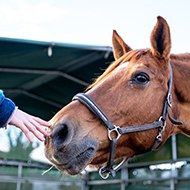
Horses were more apprehensive when they could smell fearful sweat.
A new study has proven that horses can smell when a human is experiencing fear or anxiety.
When exposed to fear-related odours, horses were found to show heightened fear responses and reduced interactions with humans.
Olfaction, or sense of smell, is considered one of the most common sensory modality used in animals to communicate. It has been researched in relation to intraspecific interactions and reproduction, but less so for emotional communication.
A new study, from the University of Tours in France, sought to investigate how scent influenced horses’ interactions with humans – particularly if they can smell fear.
To investigate this, researchers invited people to watch scenes from a horror film (Sinister) and a comedy (Singing in the Rain). As they watched, cotton pads collected their sweat from fearful and joyful situations respectively.
These cotton pads, including some unused pads as control samples, were fixed upon the muzzles of 43 horses.
These horses then underwent a series of tests to observe how these odours impacted their responses. These were fear tests, such as suddenness and novelty tests, as well as human interaction tests regarding grooming and approach.
Behaviour analysis revealed that, overall, horses exhibited significantly different responses when exposed to fear-related human odours.
Fear-related human odours resulted in the horses showing heightened fear responses and reduced interactions with humans. Horses touched the human less during the human approach test, gazed more at a novel object, and were more easily startled.
Researchers say that this study highlights the significance of chemosignals during interspecific interactions.
The findings offer insights into the impact of horses’ domestication on their emotional communication. It also has practical implications, linking the emotional state of handlers with their horse’s response to different stimuli.
The study is expected to inform new training programs, which could integrate human emotional awareness and develop strategies to reduce stress transmission between humans and horses.
The full study can be found in the journal PLOS One.
Image © WRCreatives/Shutterstock.com





 The Federation of Independent Veterinary Practices (FIVP) has announced a third season of its podcast, Practice Matters.